Hi all- I just wanted to let you know that my blog is moving! I am taking most of the old posts over, and the new blog can be found at:
http://www.economistsdoitwithmodels.com
I am in the process of bringing the posts and comments over, so bear with me! I think the new, more customizable blog will make for a more enjoyable reading experience.
Enjoy!
Sunday, July 27, 2008


Saturday, July 19, 2008
Incentives Aren't Always About Compensation...
So, I am sitting at home on a beautiful Saturday afternoon watching a baseball game between the Boston Red Sox and the Los Angeles Angels of Anaheim. (I know, I have issues.) Unlike most games, this one is on FOX, and, while I love Jerry Remy and Don Orsillo, it's a nice change to hear what other anouncers have to say. One of the more interesting points that they brought up was how well-trained the Angels players are in terms of the overall spectrum of baseball skills (sacrifices, bunting, strategic running, etc.). They credited the Angels' minor league organization for this fact, saying that the minor league managers were somewhat unique in that they were more focused on developing players' skills than on specifically winning games. Put that way, the managers' goal makes perfect sense- I don't really think there is a large benefit for a team due to a winning minor league organization. Furthermore, the incentives for the players are such that they are much more willing to practice and experiment in the minor leagues than they would be when a whole bunch of people (fans, other teams, etc.) are watching and critiquing. So why doesn't this happen more often?
I am not overly familiar with the contracting structures for minor league managers, but I highly doubt that their compensation is directly dependent on the number of games that they win. (Players aren't allowed to contract on such things, so it would stand to reason that managers can't- or won't- either, especially since no one seems to care about the minor league records.) Therefore, an economist might argue that there are no perverse incentives at play since there is no direct compensation for wins, which would incentivize wins at the expense of drilling fundamentals. However, the FOX announcers are quick to point out that there are indirect incentives for wins because minor league managers use their records as a selling point when angling for a promotion.
How can this unintended incentive be corrected for? One solution would be for an organization to commit to not using win-loss records in promotion decisions. This would work well for internal promotions, and seems to be roughly what goes on with player promotion to the big leagues. (There isn't a particularly high correlation between minor league stats and getting called up.) But this would be ineffective overall, since an organization cannot prevent other teams from considering the records in external hiring decisions. A practical solution, then, would be to offer a competing incentive. Ideally, you would want to incentivize based on how well the manager drills the basic skills. Unfortunately, this is hard to measure, especially without distorting incentives in other ways, and there is a clear bias towards providing incentives for things that the easily measured. That said, the organization that can overcome that issue will end up with a very well-trained major league team, not to mention (theoretically) higher value for its minor league prospects.
I am not overly familiar with the contracting structures for minor league managers, but I highly doubt that their compensation is directly dependent on the number of games that they win. (Players aren't allowed to contract on such things, so it would stand to reason that managers can't- or won't- either, especially since no one seems to care about the minor league records.) Therefore, an economist might argue that there are no perverse incentives at play since there is no direct compensation for wins, which would incentivize wins at the expense of drilling fundamentals. However, the FOX announcers are quick to point out that there are indirect incentives for wins because minor league managers use their records as a selling point when angling for a promotion.
How can this unintended incentive be corrected for? One solution would be for an organization to commit to not using win-loss records in promotion decisions. This would work well for internal promotions, and seems to be roughly what goes on with player promotion to the big leagues. (There isn't a particularly high correlation between minor league stats and getting called up.) But this would be ineffective overall, since an organization cannot prevent other teams from considering the records in external hiring decisions. A practical solution, then, would be to offer a competing incentive. Ideally, you would want to incentivize based on how well the manager drills the basic skills. Unfortunately, this is hard to measure, especially without distorting incentives in other ways, and there is a clear bias towards providing incentives for things that the easily measured. That said, the organization that can overcome that issue will end up with a very well-trained major league team, not to mention (theoretically) higher value for its minor league prospects.
Tuesday, July 15, 2008
The Office Understands Economics...
Angela: Gift baskets are... the essence of class and fanciness. They are the ultimate present that a person can receive.
Dwight: What about cash? With cash you can buy whatever you want, including a gift-basket, so... it's kind of the best gift ever.
Jim: What about a gift basket full of cash?
Andy: Yes! Cash-basket! Nice work, Tuna.
Dwight: What about cash? With cash you can buy whatever you want, including a gift-basket, so... it's kind of the best gift ever.
Jim: What about a gift basket full of cash?
Andy: Yes! Cash-basket! Nice work, Tuna.
Monday, July 14, 2008
Bueller...Bueller...And the Disposition Effect...
Okay, I have to admit that I can't see Ben Stein's byline without thinking of his character (an economics teacher, of course) in Ferris Bueller's Day Off. As such, I am including a visual reminder for your viewing pleasure:
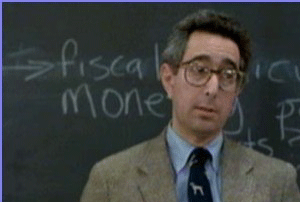
But I digress...Ben Stein has an article in today's NYT entitled "Lessons in Love, by Way of Economics". This article briefly describes the economic principles that, he argues, *should* guide our romantic choices. One part caught my interest in particular:
"When you have a winner, stick with your winner. Whether in love or in the stock market, winners are to be prized."
Now, consider the empirical finding in the stock market (called the disposition effect) that investors have a bias towards selling off winners (to realize gains) and holding on to losers (to avoid realizing losses). I am scared to think about how the disposition effect carries over to the relationship market. *shudders*
For way more disposition effect references than you would ever want, see here.
But I digress...Ben Stein has an article in today's NYT entitled "Lessons in Love, by Way of Economics". This article briefly describes the economic principles that, he argues, *should* guide our romantic choices. One part caught my interest in particular:
"When you have a winner, stick with your winner. Whether in love or in the stock market, winners are to be prized."
Now, consider the empirical finding in the stock market (called the disposition effect) that investors have a bias towards selling off winners (to realize gains) and holding on to losers (to avoid realizing losses). I am scared to think about how the disposition effect carries over to the relationship market. *shudders*
For way more disposition effect references than you would ever want, see here.
Wednesday, June 18, 2008
A Primer on Ricardian Equivalence (or "Why You Should Put Your Tax Rebate In A Savings Account")...
(Note: thanks to Tim Harford for reminding me that this issue was bugging me.)
Ok, I've seen two tax rebates in recent years (one back in 2001 and one this year), and I get that the political idea is to get cash back into the hands of citizens so that they can use it to buy stuff. In economic terms, spending the tax rebate stimulates aggregate demand and (temporarily) raises the nation's output and income. (If you don't see this, consider that people wanting to buy more stuff creates jobs, and those people working the new jobs get money, which they use at least some of to buy more stuff, which creates more jobs, and so on. Look up Keynes and the multiplier effect if you're still curious.)
In a way, the government is hoping that people don't stop to think where the "free" money comes from. Where *does* it come from? Generally speaking, the U.S. government is not a profitable enterprise, so if it wants to give out money, it has to get that money from somewhere. (Given that there is a national debt, the money isn't just sitting around in a government vault.) There are basically two options- the government can reduce spending and give the money that it would have spent back to people, or it can borrow money to give back to people. Given that reducing spending is likely to lower aggregate demand, take some jobs away, etc., that doesn't seem like the way to go to stimulate the economy. (Keynesian economists argue that FDR's increasing goverment spending went a long way to get the U.S. out of the Great Depression, for example.) Therefore, the funding of the tax rebate is through government borrowing.
Why does this matter? Well, there is the simple matter that borrowed money has to be paid back eventually, with interest even. (Macroeconomic models typically rule out the possibility of a Ponzi Scheme that would allow the government to keep borrowing more and more money without limit to pay the interest on the existing debt. This is most likely a realistic limitation, though it seems sometimes as though we are trending in that direction.) Where is the government going to get this money? From future taxes of course! Essentially what the government is doing is borrowing money on your behalf (albeit at a lower rate than you could borrow) and giving it to you as a "rebate", but there will come a time when it needs the money back (plus interest) to pay its creditors (hello China). When you think about it this way, are you going to spend or save your borrowed money? I might spend it if I thought I was old enough to not be likely to see the future tax increase, but that's about it. Even then, I should probably leave it to my (hypothetical) next of kin, since they are going to have to pay for the rebate that I got.
Economists like to put names to theories, and they like even more to name theories after themselves. The idea that debt-financed tax cuts or rebates are ineffectual in stimulating demand because people realize that the money will be paid back later in the form of higher taxes is a variant on Ricardian Equivalence. (Note that the theory of Ricardian Equivalence would also imply that increases in government spending via borrowing would also be demand neutral, in contrast to the multiplier effect described above.) Clearly Ricardian Equivalance can't hold in practice in the tax rebate case, since if it did the government (hopefully) wouldn't bother with the rebate.
Thinking from the consumer perspective, when might a household choose to spend the rebate? Maybe, as noted above, the household unit is old and doesn't really care about its children (or doesn't have any). Perhaps the household realizes the interest effect, but also realizes that the government's interest rate is pretty low and decides that consumption now is worth paying the interest later, even if it wouldn't have chosen to borrow on its own in order to finance consumption. It could even be the case that the household realizes that its tax position changes over time (due to expected income and policy changes) and it's not likely to bear the brunt of paying back the rebate. (Those nearing retirement or planning a career change to street performer could be in this category.) All of these explanations seem perfectly rational, even in the strict economic sense, and are thus not worrisome to me. That said, there are explanations for rebate consumption that are likely not utility-maximizing in the long run, and they are the ones that make me feel like the government is taking advantage of human behavior a little. My list so far is the following:
1. Households are impatient and tend to overvalue present consumption and immediate gratification. Furthermore, households are often time-inconsistent in this way, which means that there will be long-term regret regarding the present consumption, even if today it seems like the right thing to do. (Look up hyperbolic discounting for more detail.)
2. Households typically exhibit various forms of mental accounting and are thus likely to handle the tax rebate differently than it would handle an equivalent amount of earned income, for example. Specifically, there is evidence that households are likely to consume more and save less of what is considered a windfall, and the windfall is likely to be spent on more hedonic and frivolous items. In this way, the government is encouraging consumption of frivolous items- just what we need in this country.
3. Households have almost all retailers on the planet screaming "Spend your rebate here!" in their faces. It's unclear whether advertising aids in utlity-maximization or just clouds the process. I myself just bought a food dehydrator from an informercial, so who knows.
4. The households for whom the rebate is most attractive are the ones who are most liquidity constrained. The rebate at a low effective interest rate might be a boon to them, but it could also be the case that the liquidity constraint was an effective self-control device.
Update: Whatever the reason, consumers aren't as forward-looking as Ricardo's theory would imply. From Greg Mankiw's blog: "Total sales at U.S. retailers rose a full percentage point in May as many consumers had more spending cash in their wallets from government rebate checks."
Ok, I've seen two tax rebates in recent years (one back in 2001 and one this year), and I get that the political idea is to get cash back into the hands of citizens so that they can use it to buy stuff. In economic terms, spending the tax rebate stimulates aggregate demand and (temporarily) raises the nation's output and income. (If you don't see this, consider that people wanting to buy more stuff creates jobs, and those people working the new jobs get money, which they use at least some of to buy more stuff, which creates more jobs, and so on. Look up Keynes and the multiplier effect if you're still curious.)
In a way, the government is hoping that people don't stop to think where the "free" money comes from. Where *does* it come from? Generally speaking, the U.S. government is not a profitable enterprise, so if it wants to give out money, it has to get that money from somewhere. (Given that there is a national debt, the money isn't just sitting around in a government vault.) There are basically two options- the government can reduce spending and give the money that it would have spent back to people, or it can borrow money to give back to people. Given that reducing spending is likely to lower aggregate demand, take some jobs away, etc., that doesn't seem like the way to go to stimulate the economy. (Keynesian economists argue that FDR's increasing goverment spending went a long way to get the U.S. out of the Great Depression, for example.) Therefore, the funding of the tax rebate is through government borrowing.
Why does this matter? Well, there is the simple matter that borrowed money has to be paid back eventually, with interest even. (Macroeconomic models typically rule out the possibility of a Ponzi Scheme that would allow the government to keep borrowing more and more money without limit to pay the interest on the existing debt. This is most likely a realistic limitation, though it seems sometimes as though we are trending in that direction.) Where is the government going to get this money? From future taxes of course! Essentially what the government is doing is borrowing money on your behalf (albeit at a lower rate than you could borrow) and giving it to you as a "rebate", but there will come a time when it needs the money back (plus interest) to pay its creditors (hello China). When you think about it this way, are you going to spend or save your borrowed money? I might spend it if I thought I was old enough to not be likely to see the future tax increase, but that's about it. Even then, I should probably leave it to my (hypothetical) next of kin, since they are going to have to pay for the rebate that I got.
Economists like to put names to theories, and they like even more to name theories after themselves. The idea that debt-financed tax cuts or rebates are ineffectual in stimulating demand because people realize that the money will be paid back later in the form of higher taxes is a variant on Ricardian Equivalence. (Note that the theory of Ricardian Equivalence would also imply that increases in government spending via borrowing would also be demand neutral, in contrast to the multiplier effect described above.) Clearly Ricardian Equivalance can't hold in practice in the tax rebate case, since if it did the government (hopefully) wouldn't bother with the rebate.
Thinking from the consumer perspective, when might a household choose to spend the rebate? Maybe, as noted above, the household unit is old and doesn't really care about its children (or doesn't have any). Perhaps the household realizes the interest effect, but also realizes that the government's interest rate is pretty low and decides that consumption now is worth paying the interest later, even if it wouldn't have chosen to borrow on its own in order to finance consumption. It could even be the case that the household realizes that its tax position changes over time (due to expected income and policy changes) and it's not likely to bear the brunt of paying back the rebate. (Those nearing retirement or planning a career change to street performer could be in this category.) All of these explanations seem perfectly rational, even in the strict economic sense, and are thus not worrisome to me. That said, there are explanations for rebate consumption that are likely not utility-maximizing in the long run, and they are the ones that make me feel like the government is taking advantage of human behavior a little. My list so far is the following:
1. Households are impatient and tend to overvalue present consumption and immediate gratification. Furthermore, households are often time-inconsistent in this way, which means that there will be long-term regret regarding the present consumption, even if today it seems like the right thing to do. (Look up hyperbolic discounting for more detail.)
2. Households typically exhibit various forms of mental accounting and are thus likely to handle the tax rebate differently than it would handle an equivalent amount of earned income, for example. Specifically, there is evidence that households are likely to consume more and save less of what is considered a windfall, and the windfall is likely to be spent on more hedonic and frivolous items. In this way, the government is encouraging consumption of frivolous items- just what we need in this country.
3. Households have almost all retailers on the planet screaming "Spend your rebate here!" in their faces. It's unclear whether advertising aids in utlity-maximization or just clouds the process. I myself just bought a food dehydrator from an informercial, so who knows.
4. The households for whom the rebate is most attractive are the ones who are most liquidity constrained. The rebate at a low effective interest rate might be a boon to them, but it could also be the case that the liquidity constraint was an effective self-control device.
Update: Whatever the reason, consumers aren't as forward-looking as Ricardo's theory would imply. From Greg Mankiw's blog: "Total sales at U.S. retailers rose a full percentage point in May as many consumers had more spending cash in their wallets from government rebate checks."
Tuesday, June 17, 2008
Why I *Heart* Honest Tea...
Most people that know me know that I like dorky econ jokes. I think I also like products that feature dorky econ jokes on their labels. Behold the label from my beverage of choice:

I swear that this was not on purpose- this label is from Honest Tea's Green Dragon Tea, which is a lightly sweetened green tea with passion fruit flavor, and I picked it up without examining the text on the label. (The label is different on other flavors.) I do, however, appreciate the sugar optimization analogy, though the more picky among you will notice that their optimal point is technically not quite at the top of the curve. Maybe their sugar choice is the result of some sort of cost-benefit analysis that is not fully shown here. :) (Sugar isn't free, after all...)
If you are curious, the Barry of Seth and Barry is Barry Nalebuff, a professor at the Yale School of Management, and Seth was one of his MBA students.

I swear that this was not on purpose- this label is from Honest Tea's Green Dragon Tea, which is a lightly sweetened green tea with passion fruit flavor, and I picked it up without examining the text on the label. (The label is different on other flavors.) I do, however, appreciate the sugar optimization analogy, though the more picky among you will notice that their optimal point is technically not quite at the top of the curve. Maybe their sugar choice is the result of some sort of cost-benefit analysis that is not fully shown here. :) (Sugar isn't free, after all...)
If you are curious, the Barry of Seth and Barry is Barry Nalebuff, a professor at the Yale School of Management, and Seth was one of his MBA students.
Thursday, June 12, 2008
More From the Land of Unintended Consequences...
As of today, two airlines have decided to start charging customers for all checked luggage. Okay, I get it, sort of- the airlines need to cover the increased cost of fuel, customers are more sensitive to base ticket prices than they are to the later add on components, especially when the point of purchase is once they're already at the airport or on the plane, etc. BUT...hasn't anyone at the airlines thought of the incentives that this creates for passengers? For a while now, airlines seem to have been steering people towards checking baggage, presumably because it makes the security checkpoint process more efficient (3-1-1 rule, anyone?) and the airline doesn't run into the lovely situation where passengers are fighting for space in the overhead bins. (Not to mention the fact that it's probably easier to smuggle something onto a plane when everyone is bringing boatloads of stuff with them.) Why would they now want to push people in the other direction? I suppose part of the answer is that the airline doesn't bear the direct cost for the security checkpoint hassle. However, I would argue that if you are making your lines longer and slower than those at other terminals for other airlines, you're going to lose customers in the long run. People are already displeased enough with airline customer service as it is, is it really worth a few $15 pieces of checked baggage to make it worse?
You may ask how this is different from charging for a movie or snack on the plane, since this strategy has seemed to work out okay. That answer is simple- your decision whether to purchase a snack on the plane doesn't affect me, whereas your bag that previously would have been checked but is now being examined in line in front of me and pushed on top of my stuff in the overhead bin does. (And there will be some of these bags, since not everyone will pay the $15.) So the aitlines are potentially inconveniencing all passegers regardless of whether they choose to pay the $15 to check their bags.
You may ask how this is different from charging for a movie or snack on the plane, since this strategy has seemed to work out okay. That answer is simple- your decision whether to purchase a snack on the plane doesn't affect me, whereas your bag that previously would have been checked but is now being examined in line in front of me and pushed on top of my stuff in the overhead bin does. (And there will be some of these bags, since not everyone will pay the $15.) So the aitlines are potentially inconveniencing all passegers regardless of whether they choose to pay the $15 to check their bags.
Wednesday, May 28, 2008
Knowledge Isn't the Solution to Everything...
As a behavioral economist, I am curious as to the degree to which making people aware of their biases would make the biases go away. For example, would people stop procrastinating (or at least be sophisticated rather than naive, in economic terms) if they were told that they were doing so? Would they make better risky choices if they were aware of the concept of loss aversion?
My conjecture, based on my reading and casual observation, is "sometimes". Often times in economic experiments it is clear that subjects that have studied economics behave differently from those who have not. (It's also possible that people who choose to study economics are just intrinsically different from others.) That said, I present the following example:
Behold the concept of anchoring...in this context, once an individual has an anchor, she is unwilling or unhappy to pay a price higher than the anchor and feels like she is getting a good deal if the price is below the anchor, even if the anchor price was completely arbitrary. Clearly I am aware that this bias exists...but fast forward to me trying to buy a Wii Fit online- I was perfectly happy to pay a price of roughly $160 on Amazon Marketplace until I noticed that the list price was $89.99. This mostly irrelevant fact did in fact prevent me from making a purchase, which shows that biases such as the ones arising from the anchoring effect are not only intellectual curiosities but have real economic impact.
(Sidenote: one could argue that I am in fact rational, and that the list price should prevent me from purchasing simply because it tells me that I will eventually be able to get the item for that price. Personally, I don't think that that explanation jives with my impatience and/or desire for immediate gratification.)
My conjecture, based on my reading and casual observation, is "sometimes". Often times in economic experiments it is clear that subjects that have studied economics behave differently from those who have not. (It's also possible that people who choose to study economics are just intrinsically different from others.) That said, I present the following example:
Behold the concept of anchoring...in this context, once an individual has an anchor, she is unwilling or unhappy to pay a price higher than the anchor and feels like she is getting a good deal if the price is below the anchor, even if the anchor price was completely arbitrary. Clearly I am aware that this bias exists...but fast forward to me trying to buy a Wii Fit online- I was perfectly happy to pay a price of roughly $160 on Amazon Marketplace until I noticed that the list price was $89.99. This mostly irrelevant fact did in fact prevent me from making a purchase, which shows that biases such as the ones arising from the anchoring effect are not only intellectual curiosities but have real economic impact.
(Sidenote: one could argue that I am in fact rational, and that the list price should prevent me from purchasing simply because it tells me that I will eventually be able to get the item for that price. Personally, I don't think that that explanation jives with my impatience and/or desire for immediate gratification.)
Monday, January 14, 2008
The Huckabee Tax Plan...
I was explaining to a friend of mine that Mike Huckabee's tax plan is going to start haunting me in my dreams...I can't seem to stop thinking about it, since it's one of those things that makes so much sense for the first 5 seconds but upon further reflection is the worst idea ever.
Primer: Huckabee's tax plan is to abolish all existing taxes, both individual and corporate, and replace them with a flat consumption tax. Households would be reimbursed for tax paid on purchases up to the poverty line in order to avoid having the tax be too regressive.
So why would it make sense? The main appealing feature is that it would (theoretically) be easier to implement, since income taxes are a big pain in the ass for a lot of people. (Also, other countries have shown significant increases in compliance as the result of a simplified tax code, which would be a good thing.) It could be done automatically at point of sale, which seems great. BUT...upon closer reading, there are monthly tax rebates available based on cumulative purchasing. This means that some 200 million checks would have to go out each month and cumulative purchases would have to be reported just like income is reported now, which puts us back to where we started in terms of administrative hassle. (Besides, don't we already approximate the point-of-sale idea for income taxes with the whole concept of witholding? Just thought I'd ask.) Unlike Huckabee implies, the system can't just reimburse each household for purchases up to the poverty line automatically, since some households may be very low spenders and thus not entitled to the full rebate. Furthermore, reimbursing retroactively creates a problem for those with liquidity constraints, whereas the current income-tax witholding system at least partially accounts for this.
So why else is it a bad idea? Let me count the ways...I will even ignore the common ones that everyone is already complaining about and focus on the more subtle issues:
Issue 1: According to Mike Huckabee's web site, the FairTax (don't you love that name?) is "a simple tax based on wealth." Ummm...wrong. Wait, let me think....no, still wrong. The only way that the FairTax, which is a consumption tax, is actually a tax based on wealth is if individuals' wealth levels and purchasing habits are always proportional. It's pretty easy to argue that this is not the case- I'm sure we all know a few $30,000 millionaires as well as the wealthy janitors and such who got that way by not buying anything and investing well.
Issue 2: Not unrelated to the issue above, a flat consumption tax is a huge boon for the super wealthy (and thus more of a burden on everone else), since they can't even begin to spend all of the money that they have- there are only so many Gulfstream G5's that Larry Page and Sergey Brin can buy, for example. (I think, in fact, that they have even chosen to share a used Boeing 767 rather than a new G5, and used goods aren't even subject to Huckabee's consumption tax!) One solution would be to place a higher tax rate on super-luxury items, but this is a) not addressed by Huckabee, and b) likely to upset/punish the producers of such items, who generally happen to employ many average or low-income individuals.
Issue 3: Huckabee's web site makes the following assertion: "Expert analyses have shown that the FairTax lowers the lifetime tax burden of all of us: single or married; working or retired; rich, poor or middle class." The page also says, in the sentence immediately before the above quote even, that the tax plan is revenue neutral. Um...if everyone is paying less over their lifetimes, this is mathematically impossible, no?
Issue 4: The rationale behind abolishing an income tax is that is seems inefficient to tax people for being productive and working more. I would argue that it might be a bit demoralizing, but not inefficient. After all, on a basic level, why do people work? They work so that they can buy things in order to improve their quality of life. A consumption tax reduces this purchasing power in largely the same way that an income tax does- who cares if you get to keep all of your $10 an hour if an after work beer now costs $12? (Obviously I am exaggerating, but you see the point.) This issue deserves a closer look as well as some economic background:
Issue 5: While it might lower landfill costs, encouraging trade in used goods (by not subjecting them to the tax) is not necessarily good for the economy, since there is not really any economic value added in pure resale. (The government statistics people must agree with me here since used goods sold are not included in the calculation of gross domestic product.) You would have to make a tenuous argument that knowledge of a good resale market would encourage people to purchase more new stuff, since they know that they can sell it later if they want to, in order to make a good case here.
Issue 6: Huckabee asserts that abolishing the corporate tax will make American products more competitive globally because it will lower prices on exports. I buy this, I really do. However, let's come back to this revenue neutral issue, i.e. the fact that tax dollars have got to come from somewhere. So if the corporate tax is at least partially baked into the price of goods produced by U.S. corporations, then other countries are helping to pay that tax when they buy our exports. Huckabee's plan implies that the consumption tax would not apply to exports (otherwise the price of exports would actually go up, not down, negating the increased competitiveness point), which means that the whole dollar amount of what used to be the corporate tax is now the reponsibility of the U.S. population. Also, the corporate tax is felt by shareholders of U.S. companies, some of which are not U.S. citizens. This amount would also shift solely to the U.S. population. Thus, there is a cost of this increased competitiveness in the form of higher taxes for American households. (If you want to think more about this concept, ponder why high-tourism states generally have high sales taxes but low property and income taxes.)
Issue 7: I actually started thinking about the tax issue in the context of Kahneman and Tversky's model of loss aversion. The general idea of loss aversion (which has been shown to exist empirically) is that losses are felt more strongly than equivalent gains. Calibration of this model suggests that losses are felt roughly twice as uch as gains. Why is this relevant here? Loss aversion predicts that a loss is felt less stongly when coupled with a gain than when coupled with another loss. In this context, the loss in question is the money that an individual is paying in taxes. With an income tax, the tax loss is coupled with a gain in the form of wages. With a consumption tax, the tax loss is coupled with a loss of money in the form of payment. Granted, there is a gain from getting the item purchased that could mitigate this effect, but the monetary loss is still present. This would also imply that the income tax would be more efficient in that it would result in less "pain" due to actually paying the tax.
Okay, I will get off my soapbox now. Go Hillary.
Sidenote: Steve Landsburg has an interesting Slate article on the Huckabee plan. Why is it that economists are so much more convincing than politicians? I do have to note, however, that the time element of consumption coming after (sometimes well after) income means that the tax rate has to be higher in order to be revenue neutral than if the time element was not an issue. Who would have ever thought that there would be a benefit to people spending money that they don't have yet?
In case you are curious: Apparently Bruce Bartlett agrees with me on a general level.
Primer: Huckabee's tax plan is to abolish all existing taxes, both individual and corporate, and replace them with a flat consumption tax. Households would be reimbursed for tax paid on purchases up to the poverty line in order to avoid having the tax be too regressive.
So why would it make sense? The main appealing feature is that it would (theoretically) be easier to implement, since income taxes are a big pain in the ass for a lot of people. (Also, other countries have shown significant increases in compliance as the result of a simplified tax code, which would be a good thing.) It could be done automatically at point of sale, which seems great. BUT...upon closer reading, there are monthly tax rebates available based on cumulative purchasing. This means that some 200 million checks would have to go out each month and cumulative purchases would have to be reported just like income is reported now, which puts us back to where we started in terms of administrative hassle. (Besides, don't we already approximate the point-of-sale idea for income taxes with the whole concept of witholding? Just thought I'd ask.) Unlike Huckabee implies, the system can't just reimburse each household for purchases up to the poverty line automatically, since some households may be very low spenders and thus not entitled to the full rebate. Furthermore, reimbursing retroactively creates a problem for those with liquidity constraints, whereas the current income-tax witholding system at least partially accounts for this.
So why else is it a bad idea? Let me count the ways...I will even ignore the common ones that everyone is already complaining about and focus on the more subtle issues:
Issue 1: According to Mike Huckabee's web site, the FairTax (don't you love that name?) is "a simple tax based on wealth." Ummm...wrong. Wait, let me think....no, still wrong. The only way that the FairTax, which is a consumption tax, is actually a tax based on wealth is if individuals' wealth levels and purchasing habits are always proportional. It's pretty easy to argue that this is not the case- I'm sure we all know a few $30,000 millionaires as well as the wealthy janitors and such who got that way by not buying anything and investing well.
Issue 2: Not unrelated to the issue above, a flat consumption tax is a huge boon for the super wealthy (and thus more of a burden on everone else), since they can't even begin to spend all of the money that they have- there are only so many Gulfstream G5's that Larry Page and Sergey Brin can buy, for example. (I think, in fact, that they have even chosen to share a used Boeing 767 rather than a new G5, and used goods aren't even subject to Huckabee's consumption tax!) One solution would be to place a higher tax rate on super-luxury items, but this is a) not addressed by Huckabee, and b) likely to upset/punish the producers of such items, who generally happen to employ many average or low-income individuals.
Issue 3: Huckabee's web site makes the following assertion: "Expert analyses have shown that the FairTax lowers the lifetime tax burden of all of us: single or married; working or retired; rich, poor or middle class." The page also says, in the sentence immediately before the above quote even, that the tax plan is revenue neutral. Um...if everyone is paying less over their lifetimes, this is mathematically impossible, no?
Issue 4: The rationale behind abolishing an income tax is that is seems inefficient to tax people for being productive and working more. I would argue that it might be a bit demoralizing, but not inefficient. After all, on a basic level, why do people work? They work so that they can buy things in order to improve their quality of life. A consumption tax reduces this purchasing power in largely the same way that an income tax does- who cares if you get to keep all of your $10 an hour if an after work beer now costs $12? (Obviously I am exaggerating, but you see the point.) This issue deserves a closer look as well as some economic background:
- From an efficiency perspective, the best markets to tax are those where the parties involved are the least elastic in terms of changing behavior as a function of price (or wage). (This minimizes what is called deadweight loss, which is basically the amount of economic well-being that evaporates into thin air as a result of a tax or other market distortion.)
- Taken in the tax context, how much do you really think that people change their work habits as a function of their take-home wage? I would argue that, because we are socially conditioned to the idea of the 40-hour work week if nothing else, the answer is likely to be "not much". To think about it another way, do you think that Bill Gates would have worked harder if his marginal tax rate were lower? The drive for innovation and success often has to do with much more than just monetary reward. (Either that or people aren't good at distinguishing LOTS AND LOTS of money from just LOTS of money.)
- On the other hand, how much do you think that people change consumption behavior as a function of price? I point you to the overwhelming growth and success of Wal-Mart as an answer to that question. (Okay, fine, technically this argument requires that they would buy more stuff at Wal-Mart than they would otherwise, but I think that that is a small leap to make.) Furthermore, psychology would suggest that the behavior change would be greater with consumption than with income because the coupling of decision-making and payment is stronger with consumption than with labor.
- Therefore, based on the above points, the income tax is likely to be more economically efficient. (I will concede that the consumption tax will encourage beneficial saving that perhaps individuals were too impatient to engage in otherwise, but that benefit doesn't outweigh the downside of the consumption tax and is way too paternalistic for my tastes.)
- In terms of economic outcome, it doesn't matter whether you tax consumers or producers, and the tax burden is generally shared by consumers (in the form of higher after-tax prices) and producers (in the form of lower pre-tax prices). This is completely overlooked in Huckabee's argument, and it means both that a) workers wouldn't see the full dollar benefit of income-tax abolition, since wages would go down in equilbrium, and b) producers don't get a free ride, since the prices for the goods that they sell (at least to American consumers) will go down in equilibrium.
- Consumption and production are economically two sides of the same coin- where is the incentive to innovate and produce when people aren't willing and/or able to buy your products? This is a factor that cannot be ignored when considering a consumption tax.
Issue 5: While it might lower landfill costs, encouraging trade in used goods (by not subjecting them to the tax) is not necessarily good for the economy, since there is not really any economic value added in pure resale. (The government statistics people must agree with me here since used goods sold are not included in the calculation of gross domestic product.) You would have to make a tenuous argument that knowledge of a good resale market would encourage people to purchase more new stuff, since they know that they can sell it later if they want to, in order to make a good case here.
Issue 6: Huckabee asserts that abolishing the corporate tax will make American products more competitive globally because it will lower prices on exports. I buy this, I really do. However, let's come back to this revenue neutral issue, i.e. the fact that tax dollars have got to come from somewhere. So if the corporate tax is at least partially baked into the price of goods produced by U.S. corporations, then other countries are helping to pay that tax when they buy our exports. Huckabee's plan implies that the consumption tax would not apply to exports (otherwise the price of exports would actually go up, not down, negating the increased competitiveness point), which means that the whole dollar amount of what used to be the corporate tax is now the reponsibility of the U.S. population. Also, the corporate tax is felt by shareholders of U.S. companies, some of which are not U.S. citizens. This amount would also shift solely to the U.S. population. Thus, there is a cost of this increased competitiveness in the form of higher taxes for American households. (If you want to think more about this concept, ponder why high-tourism states generally have high sales taxes but low property and income taxes.)
Issue 7: I actually started thinking about the tax issue in the context of Kahneman and Tversky's model of loss aversion. The general idea of loss aversion (which has been shown to exist empirically) is that losses are felt more strongly than equivalent gains. Calibration of this model suggests that losses are felt roughly twice as uch as gains. Why is this relevant here? Loss aversion predicts that a loss is felt less stongly when coupled with a gain than when coupled with another loss. In this context, the loss in question is the money that an individual is paying in taxes. With an income tax, the tax loss is coupled with a gain in the form of wages. With a consumption tax, the tax loss is coupled with a loss of money in the form of payment. Granted, there is a gain from getting the item purchased that could mitigate this effect, but the monetary loss is still present. This would also imply that the income tax would be more efficient in that it would result in less "pain" due to actually paying the tax.
Okay, I will get off my soapbox now. Go Hillary.
Sidenote: Steve Landsburg has an interesting Slate article on the Huckabee plan. Why is it that economists are so much more convincing than politicians? I do have to note, however, that the time element of consumption coming after (sometimes well after) income means that the tax rate has to be higher in order to be revenue neutral than if the time element was not an issue. Who would have ever thought that there would be a benefit to people spending money that they don't have yet?
In case you are curious: Apparently Bruce Bartlett agrees with me on a general level.
Thursday, January 10, 2008
On the Importance of General Equilibrium Analysis...
Okay, I have to admit it: I love the Fug Girls. They are hilariously mean, and I am always up for a good celebrity fashion train wreck. I never would have guessed, however, that they would stumble upon a real-world example of the importance of general equilibrium models to analyze economic welfare. They show pretty convincingly in their New York Magazine blog post that the Writers' Guild strike has far-reaching consequences that are both economic and non-economic in nature. For example, I'll bet no one took into consideration the loss of economic surplus by seamstresses who aren't getting paid because there are no Golden Globe gowns to sew. What did they ever do to the writers of America to deserve this?
What exactly is my point here? you may ask...well, my economics textbook tells me that, when externalities are present, the government can actually raise surplus by intervening in a market. In a way, there is a positive externality associated with showbiz writing, apparently, since it keeps other (non-showbiz) people in business. Neither the writers nor the producers seem to care about this, which isn't terribly surprising since they don't have an incentive to care. Historically, if the product at hand were cars rather than scripts, the government would likely be stepping in to bring an end to/mitigate the effects of this nonsense. At what point does that become justified in this case? If I have to go too long without new episodes of Gossip Girl I am going to be very cranky...
(Let it be known that I am not against the idea of collective bargaining in general, but I find it hard to believe that the current situation is profit-maximizing for anyone.)
What exactly is my point here? you may ask...well, my economics textbook tells me that, when externalities are present, the government can actually raise surplus by intervening in a market. In a way, there is a positive externality associated with showbiz writing, apparently, since it keeps other (non-showbiz) people in business. Neither the writers nor the producers seem to care about this, which isn't terribly surprising since they don't have an incentive to care. Historically, if the product at hand were cars rather than scripts, the government would likely be stepping in to bring an end to/mitigate the effects of this nonsense. At what point does that become justified in this case? If I have to go too long without new episodes of Gossip Girl I am going to be very cranky...
(Let it be known that I am not against the idea of collective bargaining in general, but I find it hard to believe that the current situation is profit-maximizing for anyone.)
Sunday, October 21, 2007
Team Hillary...
I have to admit that I have become increasingly distracted in the last few months by the debates surrounding the upcoming 2008 presidential election. (I'm beginning to think that my involvement with Kennedy School has pushed me pretty far towards the policy wonk end of the spectrum, and I've decided that I am okay with that.) I even went so far as to spend an hour on the phone with my mom trying to convince her not to be a Repulican (sorry Mom). I get that the majority of (academic) economists are diehard Republicans, and I don't disagree with any of the "free markets are king" models of Econ 101. That said, most of those models rely on at least one of two assumptions: first, that a dollar to one person is the same as a dollar to another person (and that some transfer of surplus could/would be executed to compensate the losers in a free market), and second, that people have the information that they need in order to make utility-maximizing decisions. (I am not even going to get into an argument over whether people are rational when left to their on devices.) I don't think these assumptions are very realistic in practice, and thus I am open to at least considering various left-wing market interventions (not to mention social policies, since I do believe that many right-wing social ideals generate considerable negative externalities, among other things). So there.
Going one step further, I am firmly planting myself on Team Hillary. While I don't dislike Obama or even Edwards, I think Hillary is, well, better. (Full disclosure: I did defect from Team Obama - as people have pointed out about Hillary, the ability to change one's mind based on new information is a strength, not a weakness.) Maybe more on that later. For now, this was a long-winded introduction to a NYT blog post about Hillary that I found pretty interesting. Specifcally, I found the comments to give an insightful feel for what people are thinking and what they care about. (General gist: it sucks to be middle class.) My favorite excerpt is the following:
"And please, don’t call her health care policies progressive. What’s progressive about requiring poor people to buy overpriced health insurance?"
I don't know- someone should ask Mitt Romney.
(P.S. On a more trivial note, for those of you who watch The Hills- I know, I know- I'm squarely on Team LC. It's important to know what you stand for. =P)
Follow up: Maureen Dowd gets at, albeit accidentally, my Hillary crush:
"And on the trail, Hillary comes across more as a pile of diligently digested data than a joyful flesh-and-blood creature."
As an economist, I have to admit that I have a particular fondness for diligently digested data...
UPDATE: I...I don't even know what to say other than I feel like Hillary has punched me in the metaphorical stomach repeatedly...for example, "let's give a gas tax holiday and fund it by taxing the oil companies"? Really? What economic advisor actually let her out of the house believing this was reasonable?
Going one step further, I am firmly planting myself on Team Hillary. While I don't dislike Obama or even Edwards, I think Hillary is, well, better. (Full disclosure: I did defect from Team Obama - as people have pointed out about Hillary, the ability to change one's mind based on new information is a strength, not a weakness.) Maybe more on that later. For now, this was a long-winded introduction to a NYT blog post about Hillary that I found pretty interesting. Specifcally, I found the comments to give an insightful feel for what people are thinking and what they care about. (General gist: it sucks to be middle class.) My favorite excerpt is the following:
"And please, don’t call her health care policies progressive. What’s progressive about requiring poor people to buy overpriced health insurance?"
I don't know- someone should ask Mitt Romney.
(P.S. On a more trivial note, for those of you who watch The Hills- I know, I know- I'm squarely on Team LC. It's important to know what you stand for. =P)
Follow up: Maureen Dowd gets at, albeit accidentally, my Hillary crush:
"And on the trail, Hillary comes across more as a pile of diligently digested data than a joyful flesh-and-blood creature."
As an economist, I have to admit that I have a particular fondness for diligently digested data...
UPDATE: I...I don't even know what to say other than I feel like Hillary has punched me in the metaphorical stomach repeatedly...for example, "let's give a gas tax holiday and fund it by taxing the oil companies"? Really? What economic advisor actually let her out of the house believing this was reasonable?
Monday, September 24, 2007
Fun With Gender Stereotypes...
As a female who used to have a job that paid pretty decently, I couldn't help but find this article in the NYT interesting. Granted, the article doesn't really bring up a new idea- it talks about the social awkwardness and frustration that can result from situations where women have higher earning power- but it's a concept that is becoming more prevalent over time as women become increasingly career-focused and (financially) successful.
From an economic perspective, what I really found notable was the following set of statistics:
"For the first time, women in their 20s who work full time in several American cities — New York, Chicago, Boston and Minneapolis — are earning higher wages than men in the same age range, according to a recent analysis of 2005 census data by Andrew Beveridge, a sociology professor at Queens College in New York.
For instance, the median income of women age 21 to 30 in New York who are employed full time was 17 percent higher than that of comparable men.
Professor Beveridge said the gap is largely driven by a gulf in education: 53 percent of women employed full time in their 20s were college graduates, compared with 38 percent of men. Women are also more likely to have graduate degrees. `They have more of everything,' Professor Beveridge said."
So there. :-P
P.S. Okay, I wasn't going to get further into this, but I couldn't resist. The current trend, as alluded to in the above quote, is for women on average to be more educated than men in the same age bracket. This is a recent phenomenon, so it applies mostly to current 20-somethings and young 30-somethings. I hope that there will be a (continuing) change in family structure that goes along with this education trend, since it is not an efficient use of educational resources for the more educated women to drop out of the work force in order to raise children. People are entitled to their preferences of course, but the employment issue becomes relevant when one considers that university education is subsidized by various parties, including the government, in the form of financial aid.
From an economic perspective, what I really found notable was the following set of statistics:
"For the first time, women in their 20s who work full time in several American cities — New York, Chicago, Boston and Minneapolis — are earning higher wages than men in the same age range, according to a recent analysis of 2005 census data by Andrew Beveridge, a sociology professor at Queens College in New York.
For instance, the median income of women age 21 to 30 in New York who are employed full time was 17 percent higher than that of comparable men.
Professor Beveridge said the gap is largely driven by a gulf in education: 53 percent of women employed full time in their 20s were college graduates, compared with 38 percent of men. Women are also more likely to have graduate degrees. `They have more of everything,' Professor Beveridge said."
So there. :-P
P.S. Okay, I wasn't going to get further into this, but I couldn't resist. The current trend, as alluded to in the above quote, is for women on average to be more educated than men in the same age bracket. This is a recent phenomenon, so it applies mostly to current 20-somethings and young 30-somethings. I hope that there will be a (continuing) change in family structure that goes along with this education trend, since it is not an efficient use of educational resources for the more educated women to drop out of the work force in order to raise children. People are entitled to their preferences of course, but the employment issue becomes relevant when one considers that university education is subsidized by various parties, including the government, in the form of financial aid.
Tuesday, September 18, 2007
News Flash!
Even Alan Greenspan is jumping on the behavioral bandwagon! Apparently he too concedes that human beings are more complex (and presumably less focused on pure self-interest) than Adam Smith professed, and he asserts that an understanding of human nature is crucial to developing suitable models of the economy. I certainly agree.
Monday, September 17, 2007
Quote of the Day
From Stephen Colbert, on the Colbert Report:
"As I said before, Al Gore's movie made money, and therefore global warming must be real. The market has spoken."
Obviously Colbert was being sarcastic, but there is something to be said for this. If I put on my pathological (to borrow a description of economists from Greg Mankiw) economist hat for a second, I start thinking about why global warming is problematic in the first place. (I admit that this is a different question than that of whether global warming exists scientifically.) On a basic level, global warming is problematic because it imparts a cost on people. But how much of a cost? If people are sufficiently rational, the cost of global warming can (theoretically) be estimated via the answer to one of the following questions:
-- How much would you be willing to pay to make global warming go away?
-- How much money would you have to be paid in order to be willing to sit back and let global warming take its course?
Unfortunately, there are a number of problems with this. First, people won't always "put their money where their mouths are" in line with their answers to hypothetical questions. Second, people typically don't even give the same estimates in response to the two questions above, even though they are objectively identical to a first approximation. Lastly, funding the problem of global warming has big potential for free-riding, so people may understate their willingness-to-pay under the assumption that others would pick up the slack.
All of that said, the fact that people are expending resources to at least learn more about global warming suggests that it's a materially real problem for a lot of people. Indeed, the market HAS spoken.
"As I said before, Al Gore's movie made money, and therefore global warming must be real. The market has spoken."
Obviously Colbert was being sarcastic, but there is something to be said for this. If I put on my pathological (to borrow a description of economists from Greg Mankiw) economist hat for a second, I start thinking about why global warming is problematic in the first place. (I admit that this is a different question than that of whether global warming exists scientifically.) On a basic level, global warming is problematic because it imparts a cost on people. But how much of a cost? If people are sufficiently rational, the cost of global warming can (theoretically) be estimated via the answer to one of the following questions:
-- How much would you be willing to pay to make global warming go away?
-- How much money would you have to be paid in order to be willing to sit back and let global warming take its course?
Unfortunately, there are a number of problems with this. First, people won't always "put their money where their mouths are" in line with their answers to hypothetical questions. Second, people typically don't even give the same estimates in response to the two questions above, even though they are objectively identical to a first approximation. Lastly, funding the problem of global warming has big potential for free-riding, so people may understate their willingness-to-pay under the assumption that others would pick up the slack.
All of that said, the fact that people are expending resources to at least learn more about global warming suggests that it's a materially real problem for a lot of people. Indeed, the market HAS spoken.
Friday, September 07, 2007
Price Discrimination, People...
For those of you that have ever taken economics, the following is merely a recap: Price discrimination occurs when the same product is sold by the same supplier to different people or groups of people at different prices. Now, economists go on to break this idea down into three categories, namely first, second and third-degree price discrimination. As a student, third-degree price discrimination is my favorite since it encompasses the idea of the student discount. With third-degree price discrimination, the idea is that when you can separate your customers into categories of "more price-sensitive" and "less price-sensitive", you (as a seller) can do better than uniform pricing by charging a higher price to the less price-sensitive group. However, this is usually framed as a lower price or a discount to the more price-sensitive group. Taken in the abstract, I doubt that people would get too much up in arms over the fairness of this type of policy.
In the United States, many forms of explicit price discrimination are illegal. However, there are ways to get around this by having the customers self-select into price points- anyone who has paid $800 for a plane ticket only to be sitting next to some guy who paid $200 6 months ago for his ticket knows what I am talking about. It seems as though Apple has taken advantage of this principle in a temporal sense, introducing its iPhone at a high price and then dropping the price by $200 two months later. As an economist, I say smart move, but apparently people are very upset (NYT). In fact, customers have made enough of a fuss that Steve Jobs has extended $100 store credits to the original iPhone owners. What irks me about the situation is that customers seem to be implying that Apple did something underhanded or shady, which is simply not the case. I have two immediate reactions to this:
1. If the iPhone were a high-fashion dress, no one would be batting an eyelash. It is commonly accepted practice in some other industries to pay a premium to get something first, when it is still new and hot rather than wait around until it is no longer new but on sale. If you were willing to pay $600 for a cool new toy, you were getting at least $600 of benefits from having the cool new toy. Get over it- you probably even got the $200 of benefits from people thinking you were cool because you had an iPhone first. Furthermore, Apple seemed to be selling plenty of iPhones at the beginning, so there probably would have been a shortage if it had been introduced at a lower price point. Someone should ask these upset consumers whether they would prefer a $600 iPhone or a waiting list.
2. I think this makes a point to those who think that behavioral economics describes phenomena that are on the fringe, as opposed to being central to "rational" decision-making. Clearly consumers' perceptions of fairness can and do have a big impact on market outcomes. (see Kahneman, Knetsch and Thaler's "Fairness as a Constraint on Profit Seeking: Entitlements in the Market") Behavioral economists would likely conjecture that customers would be less upset if they thought that Apple was reducing the price of the iPhone due to a sales slump.
Lastly, I have to point out my favorite part of the article:
"Ken Dulaney, a vice president at Gartner Research, said that in general starting high and dropping the price slowly was a smart strategy. By starting the price high, manufacturers can gauge early demand and reap greater profit from early adopters who are willing to pay any amount to be the first with a particular device. 'It’s probably a formula taught in business school,' Mr. Dulaney said."
You don't have to graduate from HBS to learn this stuff, all you need is a first-year microeconomics course! That said, I'm going to go ask my iPhone-owning MBA student friend how he views the situation.
Update: Apparently Tyler Cowen agrees with me here. Economists of the world unite!
In the United States, many forms of explicit price discrimination are illegal. However, there are ways to get around this by having the customers self-select into price points- anyone who has paid $800 for a plane ticket only to be sitting next to some guy who paid $200 6 months ago for his ticket knows what I am talking about. It seems as though Apple has taken advantage of this principle in a temporal sense, introducing its iPhone at a high price and then dropping the price by $200 two months later. As an economist, I say smart move, but apparently people are very upset (NYT). In fact, customers have made enough of a fuss that Steve Jobs has extended $100 store credits to the original iPhone owners. What irks me about the situation is that customers seem to be implying that Apple did something underhanded or shady, which is simply not the case. I have two immediate reactions to this:
1. If the iPhone were a high-fashion dress, no one would be batting an eyelash. It is commonly accepted practice in some other industries to pay a premium to get something first, when it is still new and hot rather than wait around until it is no longer new but on sale. If you were willing to pay $600 for a cool new toy, you were getting at least $600 of benefits from having the cool new toy. Get over it- you probably even got the $200 of benefits from people thinking you were cool because you had an iPhone first. Furthermore, Apple seemed to be selling plenty of iPhones at the beginning, so there probably would have been a shortage if it had been introduced at a lower price point. Someone should ask these upset consumers whether they would prefer a $600 iPhone or a waiting list.
2. I think this makes a point to those who think that behavioral economics describes phenomena that are on the fringe, as opposed to being central to "rational" decision-making. Clearly consumers' perceptions of fairness can and do have a big impact on market outcomes. (see Kahneman, Knetsch and Thaler's "Fairness as a Constraint on Profit Seeking: Entitlements in the Market") Behavioral economists would likely conjecture that customers would be less upset if they thought that Apple was reducing the price of the iPhone due to a sales slump.
Lastly, I have to point out my favorite part of the article:
"Ken Dulaney, a vice president at Gartner Research, said that in general starting high and dropping the price slowly was a smart strategy. By starting the price high, manufacturers can gauge early demand and reap greater profit from early adopters who are willing to pay any amount to be the first with a particular device. 'It’s probably a formula taught in business school,' Mr. Dulaney said."
You don't have to graduate from HBS to learn this stuff, all you need is a first-year microeconomics course! That said, I'm going to go ask my iPhone-owning MBA student friend how he views the situation.
Update: Apparently Tyler Cowen agrees with me here. Economists of the world unite!
Tuesday, September 04, 2007
Who Needs Data Anyway?
This is disturbing (from the NYT):
"Just before the break, the House of Representatives passed a bill that would cut $23.6 million from the bureau’s 2008 budget for compiling the nation’s most important economic statistics. A cut of that size would result in the largest loss of source data since the government started keeping the statistics during the Great Depression, impairing the accuracy of figures on economic growth, consumer spending, corporate profits, labor productivity, inflation and other benchmark indicators."
Eh, I suppose I really wanted to be a theory person anyway. Sarcasm aside though, I find it very frustrating that, at a time where economics is becoming more popular (and people increasingly understand the importance of economic analysis) and students and researchers at all levels are learning advanced techniques to analyze economic data, one of the main providers of data is deciding that its collection is declining in priority. My guess is that the government will replace at least some of the cost by giving grants to other institutions to collect such information.
"Just before the break, the House of Representatives passed a bill that would cut $23.6 million from the bureau’s 2008 budget for compiling the nation’s most important economic statistics. A cut of that size would result in the largest loss of source data since the government started keeping the statistics during the Great Depression, impairing the accuracy of figures on economic growth, consumer spending, corporate profits, labor productivity, inflation and other benchmark indicators."
Eh, I suppose I really wanted to be a theory person anyway. Sarcasm aside though, I find it very frustrating that, at a time where economics is becoming more popular (and people increasingly understand the importance of economic analysis) and students and researchers at all levels are learning advanced techniques to analyze economic data, one of the main providers of data is deciding that its collection is declining in priority. My guess is that the government will replace at least some of the cost by giving grants to other institutions to collect such information.
Monday, August 20, 2007
Mad Money...
When I go to the gym in the evening (which I don't do nearly as often as I should), I somehow always end up at one of the elliptical trainers in front of the television showing CNBC. This means that I am reasonably familiar with Jim Cramer's show Mad Money. Stock picking isn't really my thing, but I find the show overall to be pretty entertaining. (Okay fine, I suppose I wouldn't mind taking over for Maria Bartiromo as the "Money Honey".) Apparently the show is also a topic of interest to behavioral finance people- Joey Engelberg, one of my fellow graduate students at Kellogg, recently presented a paper that shows a short-term spike in stock price and trading volume for those stocks recommended during Jim Cramer's "Lightning Round". Luckily, we have hedge funds to keep our markets efficient (mild sarcasm), and Engelberg and his co-authors find that the effect dissipates quickly. So Jim Cramer can drive the market, or at least he could before people caught on to this effect, but can he pick stocks?
Apparently Reuters has taken up the issue, and it's analysts show that Jim Cramer's picks haven't beaten the market over the last two years. Hmph...and here I thought I was being at least a little smart for not watching Friends reruns.
Apparently Reuters has taken up the issue, and it's analysts show that Jim Cramer's picks haven't beaten the market over the last two years. Hmph...and here I thought I was being at least a little smart for not watching Friends reruns.
Friday, August 17, 2007
More on College Rankings...
So some university officials are still up in arms about the U.S. News College Rankings, but most seem to still be playing along. There is another article in the NYT today. My guess is that there are some interesting questions to be answered by picking through the historical rankings data, but I'm going to have to think about that some more...
Thursday, August 16, 2007
The Best of Intentions?
So perhaps there really is no such thing as a free lunch. According to today's NYT, CARE is turning down in-kind funds for food aid. Why would they ever do this? Well, this is the lowdown, as I get my head around it:
1. The American government buys agricultural products from American farmers. However, the government pays above market prices to the farmers as a form of subsidy. (This creates allocative inefficiency in that too much of the agricultural products are being produced in the U.S.)
2. The government then ships said agricultural products to Africa using American shipping companies. This again creates inefficiency, since now not only are the farm products being produced where it's more expensive to produce, but resources are being spent to ship them almost halfway around the world when they could be grown in Africa.
3. The government gives these agricultural products to CARE, which sells the farm products to people in Africa and uses the proceeds to finance antipoverty programs.
My head is not around this yet, since as an economist I think my brain might explode as a result of reading the article. My problems with it, in order of descending ease of explanation: (Note that the problems don't even have to start with the fact that the gifts are making life more difficult for African farmers.)
1. Mental accounting issues aside, economists would argue that cash gifts are always better, since the giver in that case doesn't have to know anything about what the receiver needs or wants. Therefore, in order for this in-kind gift to be efficient, there must be some cost advantage to providing agricultural products rather than direct monetary funding. Looking, looking...nope, don't see a cost advantage. It is worth noting, however, that giving a subsidy of $100 is better in terms of U.S. surplus than just giving $100 to CARE directly, since domestic farmers and shippers do see a bump in surplus from the subsidy. The caveat is that the $100 subsidy to $100 cash gift is not the relevant comparison- $100 worth of U.S. agricultural products could be grown (and thus purchased) in Africa for much less than $100.
2. This plan seems like a sneaky way of making subsidies look good...how can people get mad about agricultural subsidies and business being thrown to the shipping companies when the output of this is going to feed poor people in Africa? Unfortunately, there is friction in this process, since $100 in subsidy for the farmer or shipper results in less than $100 of extra profit, or surplus, for them. The difference goes to cover marginal costs, obviously, so the government is subsidizing an entire value chain, the extent of which it may or may not be aware of. (Maybe subsidizing shovel manufacturers doesn't sound so bad, but what about the fuel that goes to power the ships?) Furthermore, the government is giving farmers a disincentive to find an industry where their labor and capital could be better used.
3. Giving the farm products to CARE essentially means that CARE's marginal cost of "production" is constant at zero, so it can sell the product at any positive price and be happy (or at least be sustainable). So CARE is basically the Wal-Mart of Africa, and has a difficult decision to make: does it charge low prices so that people can eat more cheaply, and undercut local production in the process? Even if it doesn't specifically undercut, one can visualize a supply and demand diagram to understand that the increased supply from the U.S. drives down market prices, which hurts African producers. This is where the article focuses, but it's not the whole story.
Taking the subsidy process as given, it is unclear why this free gift is automatically detrimental to the African people- how can a product that is useful and free be harmful? By definition, if you are endowed with something that provides positive marginal utility, you are better off than you were without the endowment. I hate to say it, since I know that CARE means well, but they really need to be smarter about their operations, at least in this case. Let's examine the situation economically to see what the organization could do:
In Africa, there are both poor producers and poor consumers to think about. The consumers are better off with the agricultural gifts, since they are getting more product at a lower market price. The African producers are worse off, since they are getting a lower price (because of the increased supply) and selling a lower quantity (since the gift is flooding the market and satisfying part of demand). CARE is better off, since it's collecting money to put back to the African people. In this way, the African producers and consumers are the ultimate beneficiaries of CARE's surplus. As long as the gains to African consumers and CARE are larger than the losses to producers (which they are, and I have the diagram to prove it!), one can devise a transfer system that ends in everyone being better off. This seems to be the piece that CARE is missing- if it compensated the producers for their losses, then everyone could be happy. Essentially, the African farmers could be getting the same profit that they were before, inclusive of the transfer from CARE, and not having to grow as much as before to get it. In fact, this is easier to implement than a transfer from consumers to producers, since CARE inherently has the coordinating mechanism to make it happen. (Counterintuitive as it may be, CARE could be doing good for Africa even if it just hands its revenue 100% back to the farmers, since the consumers still benefit from lower prices.)
Final note: it is important to think about these issues in a dynamic context, since the free farm products probably won't last forever. The above transfer would allow the African farmers to stay in business so that their societies wouldn't be left in the lurch when the aid goes away.
1. The American government buys agricultural products from American farmers. However, the government pays above market prices to the farmers as a form of subsidy. (This creates allocative inefficiency in that too much of the agricultural products are being produced in the U.S.)
2. The government then ships said agricultural products to Africa using American shipping companies. This again creates inefficiency, since now not only are the farm products being produced where it's more expensive to produce, but resources are being spent to ship them almost halfway around the world when they could be grown in Africa.
3. The government gives these agricultural products to CARE, which sells the farm products to people in Africa and uses the proceeds to finance antipoverty programs.
My head is not around this yet, since as an economist I think my brain might explode as a result of reading the article. My problems with it, in order of descending ease of explanation: (Note that the problems don't even have to start with the fact that the gifts are making life more difficult for African farmers.)
1. Mental accounting issues aside, economists would argue that cash gifts are always better, since the giver in that case doesn't have to know anything about what the receiver needs or wants. Therefore, in order for this in-kind gift to be efficient, there must be some cost advantage to providing agricultural products rather than direct monetary funding. Looking, looking...nope, don't see a cost advantage. It is worth noting, however, that giving a subsidy of $100 is better in terms of U.S. surplus than just giving $100 to CARE directly, since domestic farmers and shippers do see a bump in surplus from the subsidy. The caveat is that the $100 subsidy to $100 cash gift is not the relevant comparison- $100 worth of U.S. agricultural products could be grown (and thus purchased) in Africa for much less than $100.
2. This plan seems like a sneaky way of making subsidies look good...how can people get mad about agricultural subsidies and business being thrown to the shipping companies when the output of this is going to feed poor people in Africa? Unfortunately, there is friction in this process, since $100 in subsidy for the farmer or shipper results in less than $100 of extra profit, or surplus, for them. The difference goes to cover marginal costs, obviously, so the government is subsidizing an entire value chain, the extent of which it may or may not be aware of. (Maybe subsidizing shovel manufacturers doesn't sound so bad, but what about the fuel that goes to power the ships?) Furthermore, the government is giving farmers a disincentive to find an industry where their labor and capital could be better used.
3. Giving the farm products to CARE essentially means that CARE's marginal cost of "production" is constant at zero, so it can sell the product at any positive price and be happy (or at least be sustainable). So CARE is basically the Wal-Mart of Africa, and has a difficult decision to make: does it charge low prices so that people can eat more cheaply, and undercut local production in the process? Even if it doesn't specifically undercut, one can visualize a supply and demand diagram to understand that the increased supply from the U.S. drives down market prices, which hurts African producers. This is where the article focuses, but it's not the whole story.
Taking the subsidy process as given, it is unclear why this free gift is automatically detrimental to the African people- how can a product that is useful and free be harmful? By definition, if you are endowed with something that provides positive marginal utility, you are better off than you were without the endowment. I hate to say it, since I know that CARE means well, but they really need to be smarter about their operations, at least in this case. Let's examine the situation economically to see what the organization could do:
In Africa, there are both poor producers and poor consumers to think about. The consumers are better off with the agricultural gifts, since they are getting more product at a lower market price. The African producers are worse off, since they are getting a lower price (because of the increased supply) and selling a lower quantity (since the gift is flooding the market and satisfying part of demand). CARE is better off, since it's collecting money to put back to the African people. In this way, the African producers and consumers are the ultimate beneficiaries of CARE's surplus. As long as the gains to African consumers and CARE are larger than the losses to producers (which they are, and I have the diagram to prove it!), one can devise a transfer system that ends in everyone being better off. This seems to be the piece that CARE is missing- if it compensated the producers for their losses, then everyone could be happy. Essentially, the African farmers could be getting the same profit that they were before, inclusive of the transfer from CARE, and not having to grow as much as before to get it. In fact, this is easier to implement than a transfer from consumers to producers, since CARE inherently has the coordinating mechanism to make it happen. (Counterintuitive as it may be, CARE could be doing good for Africa even if it just hands its revenue 100% back to the farmers, since the consumers still benefit from lower prices.)
Final note: it is important to think about these issues in a dynamic context, since the free farm products probably won't last forever. The above transfer would allow the African farmers to stay in business so that their societies wouldn't be left in the lurch when the aid goes away.
Wednesday, August 15, 2007
Economics Really is Everywhere...
Okay, so I'm sitting here minding my own business and reading the NYT style section...I get to an article titled "Buy Low, Divorce High", and as anyone even mildly cynical about relationships would do, I begin reading. The general gist of the article is that the rising values of homes/condos for married couples is tending to lead to divorce, since the people involved recognize that they could live comfortably by themselves as a result of the large profit on their real estate. I can't help but think that it's a bit sad that financial insecurity is what keeps a lot of relationships together, but I digress. Anyway, I get to about the middle of the first page of the article only to find that the author starts referring to the work of Gary Becker. In the style section? Apparently Becker is trendy and I didn't know it.
To quote the article:
"Economists are familiar with this phenomenon. Even though divorce rates are declining over all, as far back as 1977 the economist Gary Becker showed that couples experiencing any unexpected, drastic rise in net worth are at risk of divorce. (The same holds true for a drastic decline in net worth.)
Extrapolating from survey data, Dr. Becker concluded in The Journal of Political Economy that “a greater deviation between actual and expected earnings increases the probability” of divorce.
Although couples who see their incomes rise steadily generally stay together, those who make more money than they ever expected are vulnerable to divorce. They realize that they are less financially dependent on each other and that they might have chosen different spouses if they had more choices at the time, said Dr. Becker, who teaches at the University of Chicago.
Dr. Becker, who won the Nobel Prize in 1992, also explored in his divorce study the economic argument for what many people today call trading up, or finding a trophy spouse."
I try hard to respect people's preferences, but really?
To quote the article:
"Economists are familiar with this phenomenon. Even though divorce rates are declining over all, as far back as 1977 the economist Gary Becker showed that couples experiencing any unexpected, drastic rise in net worth are at risk of divorce. (The same holds true for a drastic decline in net worth.)
Extrapolating from survey data, Dr. Becker concluded in The Journal of Political Economy that “a greater deviation between actual and expected earnings increases the probability” of divorce.
Although couples who see their incomes rise steadily generally stay together, those who make more money than they ever expected are vulnerable to divorce. They realize that they are less financially dependent on each other and that they might have chosen different spouses if they had more choices at the time, said Dr. Becker, who teaches at the University of Chicago.
Dr. Becker, who won the Nobel Prize in 1992, also explored in his divorce study the economic argument for what many people today call trading up, or finding a trophy spouse."
I try hard to respect people's preferences, but really?
Subscribe to:
Posts (Atom)
